Roof Coating Near Me: What West Midlands Property Owners Need to Know
Searching for Roof Coating Near Me is one of those decisions that tends to happen at a specific moment — you've spotted something worrying on a flat roof, a maintenance survey has flagged early deterioration, or a neighbouring property has just had work done and it's prompted you to check your own. Whatever brought you here, this guide is written to help you understand what roof coating actually involves, when it's the right call, and what separates a competent job from a poor one.
Our team has spent 10 years working on roofing projects across the West Midlands, serving 150+ clients across commercial and residential properties. We hold CSCS and CHAS accreditations, work to RAMS standards on every project, and back our coating work with a 20 years coating warranty — not because it's a marketing phrase, but because a coating applied correctly to a sound substrate genuinely lasts that long.
The following sections address the questions we hear most often from property owners and facilities managers who are doing exactly what you're doing now: researching before committing.
What Roof Coating Actually Is (And What It Isn't)
A liquid-applied waterproofing membrane that bonds to an existing roof surface, roof coating creates a seamless, weather-resistant layer that extends the serviceable life of the substrate beneath it. It is not a patch repair, not a temporary fix, and not a substitute for structural remediation where underlying decking or joists have failed.
The distinction matters. Coating is appropriate when:
- The existing membrane or built-up felt is weathered but structurally intact
- Lap joints are lifting or seams are showing early signs of separation
- Ponding water is causing localised breakdown of the surface
- A property is approaching end-of-life on its current roofing system but full replacement isn't yet warranted
It is not appropriate when the roof deck is saturated, when there is active delamination across large areas, or when structural movement has caused widespread cracking. In those cases, coating would simply encapsulate the problem rather than address it.
Modern systems are typically either elastomeric (rubber-based, highly flexible) or polyurethane — both designed to accommodate thermal movement without cracking. A polymer-based system that stretches and returns to its original dimensions as temperatures fluctuate, elastomeric roof coating is particularly well-suited to larger commercial roofs where expansion and contraction stresses are greater.
When to Search for Roof Coating Near Me
Timing matters more with roof coatings than most property owners realise. The window between "the roof needs attention" and "the roof needs replacing" is real but finite.
The clearest indicators that coating is timely — rather than premature or too late — are:
Surface oxidation and chalking. On felt and built-up systems, the bitumen gradually loses its oils and the surface becomes brittle. Running your hand across it leaves a chalky residue. This is the ideal point to coat: the substrate is still sound, the adhesion will be strong, and you're protecting the layers beneath before water ingress begins.
Minor lap joint movement. Seams between sheets lift fractionally over years of thermal cycling. Catching this before water tracks beneath the lap prevents the much more expensive scenario of saturated insulation and decayed decking.
Ponding without leaking. Standing water after rain that doesn't drain within 48 hours accelerates deterioration. Coating at this stage, combined with any minor drainage improvement, prevents the ponding from becoming a leak.
Post-survey recommendations. If a maintenance survey has rated the roof amber — not yet failing, but showing signs of age — coating is typically the correct professional response.
For West Midlands commercial properties in particular, where flat roofs on industrial units, retail premises, and older office buildings are common, the cost of missing this window is usually a full roof replacement rather than a coating. The two are not remotely comparable in disruption or expenditure.
How Roof Coating Is Applied: The Process in Plain Terms
Understanding what's involved helps you evaluate quotes and spot corners being cut. A properly executed coating project follows a clear sequence.
Inspection and substrate assessment comes first. Before any product is specified, the existing roof needs to be walked, probed in suspect areas, and assessed for moisture content where possible. The coating system specified should match the substrate — a system right for felt may differ from one suited to fibreglass or single-ply membrane.
Cleaning and preparation is where most of the labour is. Moss, algae, dust, and any loose material must be removed thoroughly. On heavily weathered roofs this typically involves pressure washing followed by a biocide treatment to prevent regrowth beneath the coating. Adhesion fails when coatings are applied over contaminated surfaces, this is one of the most common causes of premature coating failure, and it's entirely avoidable.
Primer application where specified by the manufacturer creates a key for the coating to bond to. Skipping primer on absorbent or weathered substrates is a false economy that becomes visible within a season.
Reinforcement membrane installation at vulnerable points, seams, penetrations, outlets, upstands, involves embedding a fibreglass scrim or reinforcement fabric into the first coat of coating while it's still wet. A woven or non-woven fabric layer embedded into the wet coating to provide tensile strength at areas of high movement stress, this reinforcement membrane prevents the coating from splitting first at flashings and laps without this essential step.
Full coating application follows, typically in two or more passes to achieve the specified dry film thickness (DFT). DFT matters: too thin and the coating won't provide the warranted lifespan; too thick in a single pass and it may not cure correctly. Good contractors document their application rates.
Final inspection and snagging on a completed roof should check that all upstands are taken up to the correct height, all outlets are clear, and there are no pinholes or missed areas in the field of the roof.
Cut Edge Corrosion: A Related Problem Worth Understanding
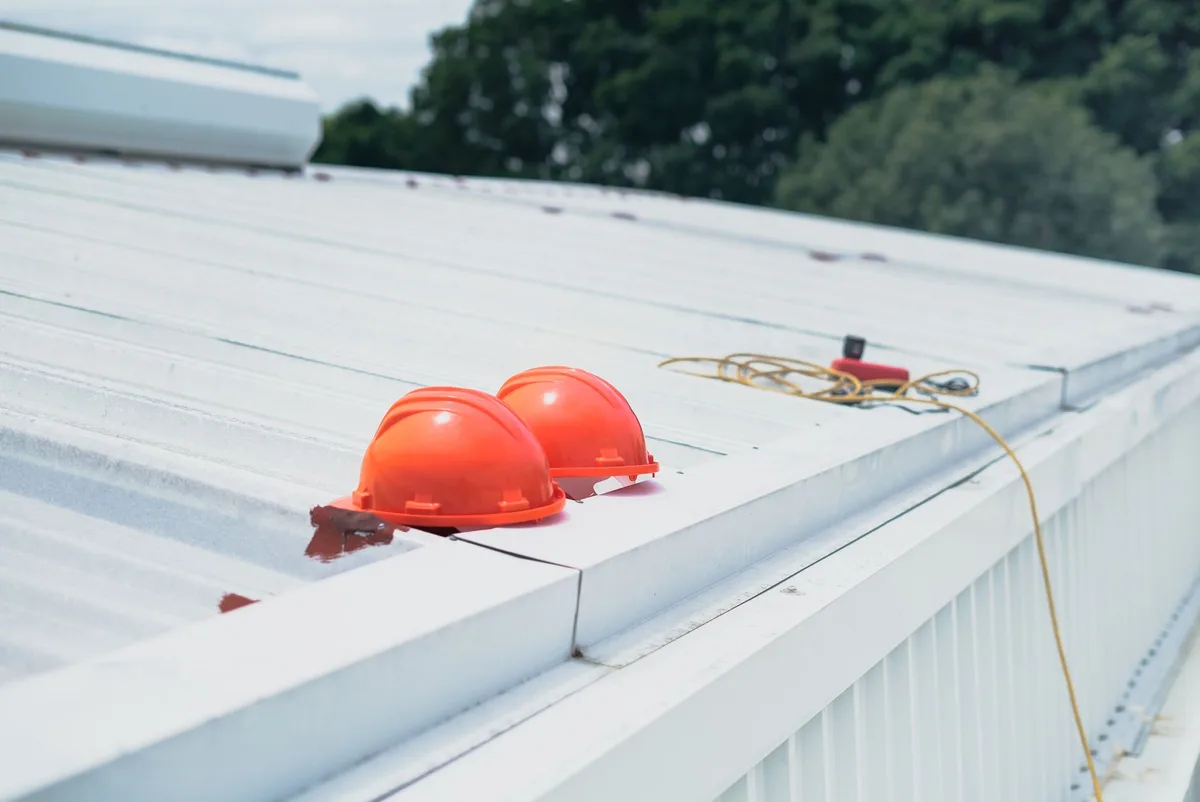
If your property has a profiled metal roof, common on industrial units, agricultural buildings, and warehousing across the West Midlands, the issue you're more likely facing isn't flat roof deterioration but cut edge corrosion.
The oxidation that occurs at the exposed, unprotected edges of profiled steel roof sheets where they were cut during installation, cut edge corrosion spreads beneath the sheet's surface coating from that point inward when factory-applied coating doesn't extend to the cut edge. Water, oxygen, and atmospheric pollution drive the rust progression over time.
Left untreated, cut edge corrosion progresses from a cosmetic issue to a structural one, eventually causing sheets to fail at the overlap, a failure mode that can affect large sections of roof simultaneously.
Our cut edge corrosion treatment service addresses this specifically, using a sequence of rust inhibitor, primer, and flexible sealant coating applied to the overlap edges. It's a different process from flat roof coating but follows the same principle: intervene before the substrate is beyond economic treatment.
If you're unsure which issue you're dealing with, a proper inspection will make it clear, the two failure modes look quite different.
Software-Only vs Professional-Led Approach to Roof Maintenance
Property managers increasingly use building management software to schedule and log roof maintenance. These platforms are useful for tracking inspection cycles and storing survey records, but they don't replace the judgement of someone who has physically assessed your specific roof.
| Software-Only | Professional-Led | |
|---|---|---|
| Upfront Cost | Lower initial outlay | Quoted per project |
| Accuracy Risk | High, relies on self-assessment | Low, assessed by experienced contractor |
| Time Investment | Significant, owner manages scheduling and diagnosis | Managed by the contractor team |
| Strategic Guidance | None, no trade expertise built in | Included, experienced advice on timing and specification |
| Compliance Confidence | Depends on user's knowledge | Higher, contractor familiar with standards and access regulations |
| Typical User | Large in-house FM teams with specialist roofing staff | Most commercial and residential property owners |
The practical gap shows up most clearly in specification decisions. Software can flag that a roof is due for maintenance based on age. It can't tell you whether the existing substrate will accept a coating system or whether the lap joints need to be fully re-sealed before coating commences. Those calls require physical inspection by someone with enough experience to have seen what happens when they're got wrong.
Our team holds Constructionline registration and PASMA certification, and approaches every project with a full RAMS document covering the specific access and safety requirements of the site.
What Affects the Cost of Roof Coating Near Me
Searches for Roof Coating Near Me often follow quickly with "how much does it cost?", a reasonable question that doesn't have a single honest answer, because cost is genuinely project-specific.
The factors that drive variation include:
Roof area. The most obvious variable. Larger roofs require more materials and more labour time, though there are economies of scale on preparation costs for straightforward large areas.
Substrate condition. A roof that requires extensive cleaning, biocide treatment, and localised repair before coating can be applied costs more to prepare than one in good condition. Cutting preparation time to cut cost is the most reliable predictor of early coating failure.
Access requirements. Roofs requiring scaffolding, MEWP (mobile elevated work platform), or specialist access over live car parks or pedestrianised areas carry higher costs than those accessible by ladder or existing roof access hatches. PASMA-certified operatives are required for scaffold tower work, this is a compliance requirement, not optional.
Coating system specified. Different products have different material costs. A heavy-duty polyurethane system appropriate for a heavily trafficked roof costs more per square metre of material than a standard elastomeric coating for a low-traffic commercial flat roof.
Number of penetrations and details. Every pipe, flue, skylight, outlet, or upstand is a detail that requires careful reinforcement and finishing. A roof with fifteen penetrations takes proportionally longer to coat correctly than one with three.
Requesting multiple quotes without a specification document means each contractor may be pricing a different scope. A detailed written specification, ideally following a proper inspection, allows genuine like-for-like comparison.
How to Assess a Roof Coating Contractor in the West Midlands
For anyone narrowing down their search after typing Roof Coating Near Me into a search engine, the quality of contractors available varies considerably. These are the markers that distinguish competent firms from those likely to underdeliver.
They inspect before they quote. Any contractor pricing a coating job without physically inspecting the roof is guessing at the specification and the preparation requirements. Walk away from quotes based on photos alone.
They can explain the system they're specifying. A competent contractor should be able to tell you why they've chosen a particular coating product for your substrate, what the application rate will be, and what the warranty covers. Vague answers to specific questions are a red flag.
They hold appropriate accreditations. CHAS registration, for example, indicates that the contractor has been assessed for health and safety competence, relevant if your property is a commercial premises with public access. CSCS cards confirm that operatives working on site have the appropriate trade certification. These aren't optional extras for professional contractors.
Their warranty is documented. Our 20 years coating warranty is issued in writing and tied to the specific system applied. Any warranty worth anything is documented, identifies the product, and specifies what's covered. Verbal assurances are unenforceable.
They carry full public documentation. A RAMS document (Risk Assessment and Method Statement) should be produced for every project. This isn't just a compliance box-tick, it demonstrates that the contractor has thought through the access, material handling, and hazard management for your specific site.
Areas We Cover for Roof Coating Near Me in the West Midlands
Our team carries out roof coating work across the West Midlands and surrounding areas. If you're searching for Roof Coating Near Me, the following location pages cover our most active areas, each with detail specific to that area's property mix and access conditions:
- Roof Coating Coventry
- Roof Coating Dudley
- Roof Coating West Bromwich
- Roof Coating Oldbury
- Roof Coating Darlaston
- Roof Coating Rowley Regis
If your location isn't listed, get in touch via our contact page, we cover a broader geography than these pages represent and are happy to confirm whether your property falls within our working area.
Frequently Asked Questions About Roof Coating
How long does a roof coating last?
Applied correctly to a sound substrate with adequate preparation, modern elastomeric and polyurethane coating systems are designed for long-term performance. Our work is backed by a 20 years coating warranty, which reflects what properly applied systems on appropriate substrates realistically achieve. Lifespan shortens significantly if preparation is inadequate or if a system is applied to a substrate that was already past the point where coating was appropriate.
Is roof coating suitable for all roof types?
Coating is appropriate for most flat and low-pitch roof types, including felt, asphalt, fibreglass (GRP), single-ply membranes, and concrete, provided the substrate is structurally sound and free from active moisture. It is not suitable as a standalone treatment for profiled metal roofs with cut edge corrosion (which requires a specific treatment process) or for roofs where the deck has failed and requires replacement.
What's the difference between roof coating and roof painting?
These terms are sometimes used interchangeably, but they describe different products. Roof paint is typically a thin decorative or reflective coating with limited waterproofing performance. Roof coating is a thicker, elastomeric or polyurethane membrane product with genuine waterproofing capability, measured to a specified dry film thickness. The performance difference is substantial, particularly for flat roofs where standing water is a factor.
Do I need to vacate the property during coating work?
For most commercial projects, no. Coating is carried out externally and doesn't require access to the interior. There may be brief periods where roof access points need to be kept clear, and some coating products have odour during application, but normal operations typically continue throughout. Your contractor should confirm specific requirements for your site as part of the pre-start discussion.
How do I know if my roof needs coating or replacement?
The key indicator is substrate condition. If the decking is dry and structurally sound, the membrane or felt is weathered but intact, and there are no active leaks that haven't been isolated, coating is likely appropriate. If the deck is saturated, there is widespread delamination, or structural movement has caused extensive cracking, replacement is the more honest recommendation. A proper inspection by an experienced contractor, not just a visual assessment from a distance, is the only reliable way to make this call.
Finding Reliable Roof Coating Near Me: The Next Step
Roof coating, done properly and at the right time, is one of the more cost-effective interventions available to property owners managing ageing flat roofs. The decision hinges on timing, acting when the substrate is still sound, and on choosing a contractor whose preparation standards match the system they're applying.
With 10 years in the trade, 150+ clients served across the West Midlands, CSCS, CHAS, PASMA, and Constructionline accreditations, and a 20 years coating warranty on our coating work, our team carries out this work to a standard we're happy to stand behind.
If you'd like an honest assessment of your roof's condition and a clear written quote, Request a free site visit and we'll arrange a time to inspect the property in person. We respond within 24 hours. There's no obligation, if the roof isn't a candidate for coating, we'll tell you that too.
You can also read more about our team and our approach before getting in touch, or browse the homepage for an overview of the full range of work we carry out.