What Is Roof Coating? A Complete Guide for UK Property Owners
Roof coating is one of those terms that gets used loosely across the construction industry, covering everything from a thin waterproofing membrane on a flat commercial roof to a reflective finish on a corrugated industrial unit. If you've been quoted for the work, or spotted signs of wear on your roof and started researching your options, understanding what roof coating actually involves will help you make a better decision — and ask better questions before any contractor sets foot on your building.
This guide covers the core principles: what roof coating is, how the different systems work, which roof types suit which approach, and what the long-term picture looks like for West Midlands properties.
What Is Roof Coating, and What Does It Actually Do?
Roof coating is a liquid-applied or system-built protective layer installed over an existing roof surface to extend its serviceable life, improve waterproofing, and in some cases enhance thermal or reflective performance. Unlike a full roof replacement, coating works with the existing substrate rather than removing it.
Most roof surfaces degrade over time through UV exposure, thermal cycling, freeze-thaw movement, and the gradual breakdown of original seals and fixings. These systems arrest that degradation by encapsulating the existing material in a durable, weatherproof layer — sealing cracks, bridging minor movement, and cutting off the moisture pathways that cause internal damage.
Depending on the system specified, roof coating can:
- Restore waterproofing integrity to an aged or failing surface
- Prevent the recurrence of ponding water-related damage
- Reduce solar heat gain through reflective pigments
- Extend the functional lifespan of an existing roof by many years
- Defer the cost and disruption of a full replacement
It is not a permanent fix for a structurally failed roof — a building with serious decking failure, widespread corrosion through the profile, or collapsing purlins needs structural work first. But for a vast category of commercial and residential roofs that are sound beneath the surface and failing at the coating level, it's a highly practical intervention.
The Main Types of Roof Coating Systems
Not all roof coatings are the same product, and the system that's appropriate for your building depends heavily on the substrate, the exposure category, and the performance requirements.
Liquid-Applied Waterproofing Membranes
Single- or multi-component polymer systems — typically polyurethane, silicone-based, or acrylic — are applied by brush, roller, or spray to form a seamless, flexible membrane over the roof surface. Because they cure to a monolithic layer with no joins or seams, they eliminate the most common water ingress points found in built-up felt or torch-on systems.
These membranes are particularly suited to flat or low-pitch roofs where standing water is a design reality. The better systems offer genuine elongation properties — meaning the membrane stretches with thermal movement rather than cracking.
Reinforced Coating Systems
On roofs with existing cracking, open laps, or movement-prone areas, a reinforcement layer (typically a polyester fleece or fibreglass tissue) is embedded into the base coat before the topcoat is applied. This bridges discontinuities in the substrate and adds tensile strength to the finished system.
This approach is the standard method for most commercial re-coating work rather than the exception — it adds meaningful durability without substantially increasing the programme length.
Reflective and Cool-Roof Coatings
High-albedo pigments reflect solar radiation rather than absorbing it. On large flat-roofed industrial or commercial units, roof surface temperatures in summer can reach 70–80°C on a standard dark surface, which accelerates membrane degradation and contributes to elevated internal temperatures. A quality reflective coating can reduce surface temperature meaningfully, easing the load on air conditioning systems and extending coating lifespan.
Cut-Edge Corrosion Treatment Systems
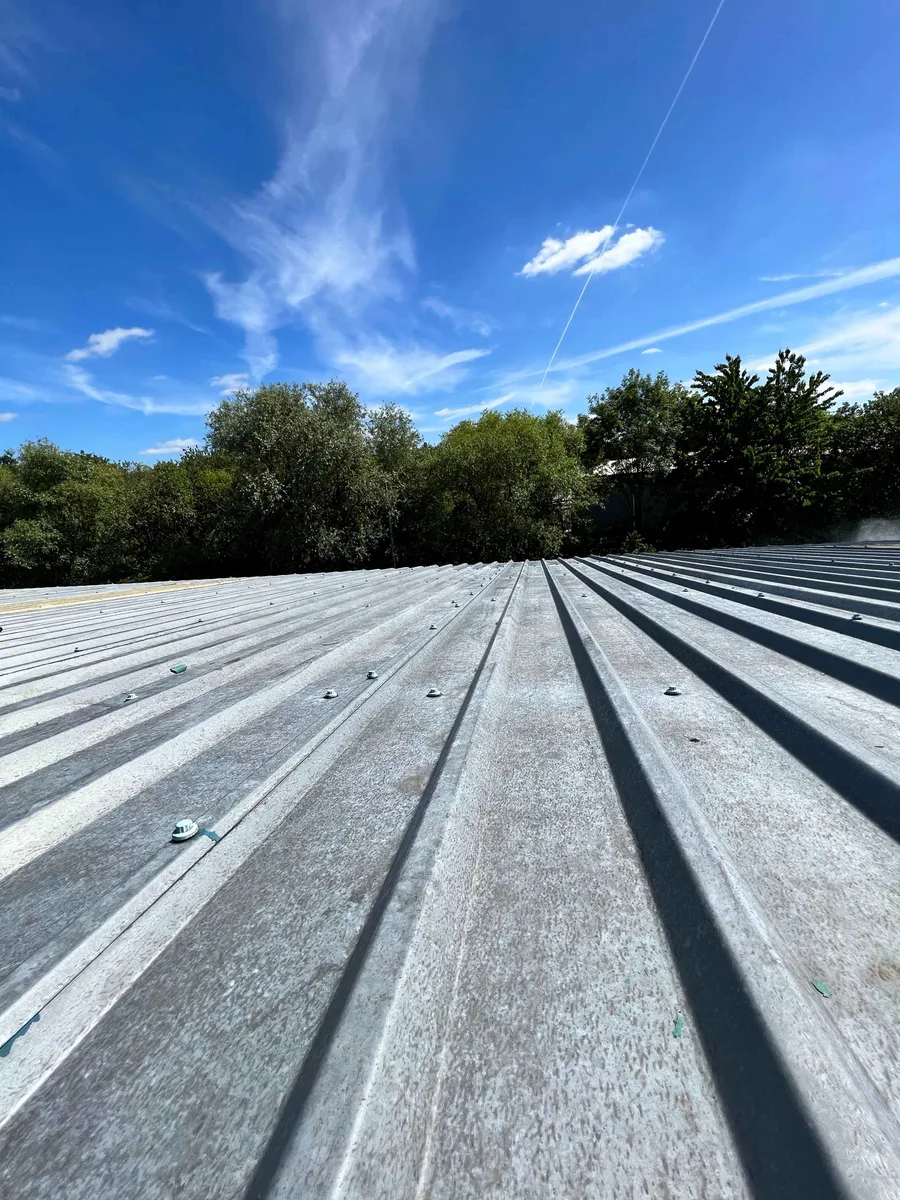
Profiled metal roofing — box profile and trapezoidal sheet most commonly — is particularly vulnerable at the cut edges, where the protective coating applied during manufacture is absent. Moisture penetrates the exposed steel, undercuts the galvanised layer, and causes red rust that progressively compromises the roof's structural capacity.
Our cut edge corrosion treatment service addresses this specific failure mode: cleaning back the corrosion, treating with a specialist primer, and applying a compatible coating system to re-seal and protect the affected areas. Left untreated, cut-edge corrosion spreads along the full length of every sheet, eventually requiring sheet replacement rather than surface treatment.
Which Roof Types Are Suited to Coating?
Coating systems are applicable to a wide range of substrates, but not every roof is a coating candidate. Here's how the main categories break down.
Profiled metal roofing (steel and aluminium) is the most common commercial coating application. These roofs degrade predictably: surface coatings chalk and fade, cut edges corrode, sealant at laps and penetrations fails, and fastener washers perish. A coating programme can address all of these without lifting a single sheet.
Modified bitumen and felt flat roofs are well-suited to liquid-applied systems, particularly where the underlying felt is still structurally sound but the surface has become brittle, split, or lost its mineral finish. Torch-on felt in particular develops surface cracks as it ages that respond well to a liquid membrane overlay.
Fibre cement (Eternit-type) roofing can be coated, though surface preparation is critical; these surfaces are porous and require primer systems to ensure adhesion.
Concrete and screed flat roofs are coatable where the screed is sound and falls are adequate. Failed concrete roofs with active water ingress will need structural repairs before coating.
Roofs that are not coating candidates include those with active structural failure, significant purlin or decking movement, severe biological growth penetrating the substrate, or where the existing coating is so delaminated that adhesion of a new system cannot be guaranteed without full strip-back.
A professional site survey, not a desktop quote, is the only reliable way to determine which category your roof falls into.
How Long Does Roof Coating Last?
Modern coating systems applied to a properly prepared substrate offer substantial service lives. Our team backs qualifying installations with a 20 years coating warranty, which reflects both the quality of the systems we specify and the importance we place on surface preparation and system selection.
That figure isn't guaranteed regardless of substrate condition. The variables that most directly affect coating longevity are:
- Surface preparation quality. This is, without question, the single biggest determinant of long-term performance. A premium coating applied over a poorly cleaned or inadequately primed surface will fail prematurely. Proper preparation, pressure washing, de-greasing, mechanical abrasion where needed, full primer application, adds time to the programme but is non-negotiable for durability.
- System selection relative to exposure. A product rated for a sheltered suburban location is not the right specification for a large-footprint industrial unit in an exposed position. Coating selection should follow a proper exposure assessment.
- Ponding water. Flat roofs with inadequate falls that allow water to sit for extended periods place a much greater demand on any coating system. Falls correction (using tapered insulation or screed) before coating significantly improves lifespan.
- Ongoing maintenance. Clearing debris from outlets, checking sealant around penetrations annually, and addressing any mechanical damage promptly all contribute to achieving the system's design life.
A well-executed coating programme on a sound substrate, using an appropriate system, should comfortably deliver 15–20+ years of effective service with basic maintenance.
The Professional Application Process: What to Expect
Understanding what a roof coating project actually involves helps you evaluate a contractor's quote and programme with confidence.
The process begins with a thorough survey, not a cursory look from ground level but a physical inspection of the roof surface, drainage, penetrations, fixings, and any existing coating or felt. This is where a knowledgeable contractor identifies the substrate condition, maps areas of concern, and determines the appropriate system and primer specification.
Surface preparation follows. On metal roofing, this typically means pressure washing, wire brushing or grinding corroded areas, and applying a corrosion-inhibiting primer to any affected zones. On felt or bitumen roofs, it means clearing debris, re-fixing any lifting sections, and priming the full surface. The preparation phase often takes as long as the coating application itself on a properly run project; if a contractor skips it or rushes it, that's a significant red flag.
The coating is then applied to the prepared surface. Most professional systems involve at least two coats, a base coat (with reinforcement fabric where specified) and a topcoat applied once the base has cured. Application rates matter: manufacturers specify minimum wet film thickness for a reason, and under-application is the second most common cause of premature system failure after poor preparation.
Final inspection checks film build, coverage of all vulnerable details (upstands, penetrations, outlet collars, laps), and documents the completed installation for warranty purposes.
Our team holds CSCS and CHAS accreditations and works to documented RAMS on every commercial roof coating project, a requirement for most managed sites and an indicator of a contractor who takes the work seriously.
Software-Only vs Professional-Led Approach to Roof Maintenance
For property managers and business owners weighing up how to manage their roof asset, this comparison is worth understanding clearly.
| Software-Only / DIY Monitoring | Professional-Led Coating Programme | |
|---|---|---|
| Upfront Cost | Low initial spend | Quoted per project |
| Accuracy Risk | High, surface condition often misread without physical inspection | Low, professional survey identifies substrate issues before work begins |
| Time Investment | Ongoing internal management burden | Managed externally with programme documentation |
| Strategic Guidance | None, monitoring only, no specification input | Full system specification matched to building type and exposure |
| Compliance Confidence | Varies, no accredited contractor involvement | CSCS, CHAS, Constructionline accreditation, RAMS documentation |
| Typical User | Small residential landlords with low-risk portfolios | Commercial property owners, facilities managers, portfolio landlords |
For commercial properties in the West Midlands, where roof access, liability, and system specification all carry meaningful consequences, a professional-led programme consistently delivers better long-term outcomes.
What to Look for When Commissioning Roof Coating Work
Choosing a contractor for roof coating isn't simply a matter of finding the lowest quote. The quality of surface preparation, system specification, and documentation makes a far greater difference to the outcome than a marginal price saving.
Key questions worth asking before you commit:
What system are you specifying, and why? A professional contractor can explain why a particular product suits your substrate and exposure. Vague answers ("we use a good coating") suggest the specification hasn't been tailored to your building.
What does your preparation programme include? Ask specifically about how they'll address corrosion, primer specification, and any detail treatment at penetrations and laps. If preparation gets a one-sentence answer, that's worth probing further.
What accreditations do you hold? For commercial roofing work, CSCS, PASMA, CHAS, and Constructionline registration are standard indicators of a contractor who meets site safety and procurement requirements. Our team holds all of these.
What warranty is provided, and what does it cover? Understand whether the warranty covers materials only or installation workmanship as well, and what obligations it places on you as the building owner (typically: annual maintenance and prompt reporting of mechanical damage).
Can you provide a written method statement and risk assessment? Any competent contractor working at height on a commercial site will have documented RAMS. If they can't provide these, that's a procurement and safety risk.
With 10 years of experience across West Midlands commercial and residential properties, and 150+ clients served, our team has the track record to back our recommendations, and we're transparent about what a project involves before any work begins.
For properties across the region, you'll find our dedicated area guides for Coventry, Dudley, West Bromwich, and Oldbury useful if you want to understand how we work locally.
Frequently Asked Questions
What Is Roof Coating typically used for?
Extending the life of an existing roof surface that is deteriorating at the coating or membrane level but remains structurally sound is the most common application. It seals cracked or failing surfaces, restores waterproofing integrity, and in reflective variants, can reduce solar heat gain. What is roof coating applicable to most flat, pitched metal, felt, and concrete roof substrates.
Is roof coating a permanent fix?
Not in the sense that any roofing material lasts indefinitely, but a properly specified and applied system backed by a 20 years coating warranty represents a long-term solution rather than a short-term patch. The key is correct surface preparation and system selection; those two factors determine whether a coating performs for its design life or fails prematurely.
How do I know if my roof needs coating or full replacement?
A physical survey by an experienced contractor is the only reliable way to answer this. Signs that coating is viable include: surface degradation with intact underlying structure, isolated leaks at laps and penetrations rather than generalised ingress, and intact decking or purlins beneath the surface material. Signs that replacement may be necessary include: structural movement, widespread cut-edge corrosion through the profile depth, or severely delaminated existing coatings.
Does roof coating work on all roof types?
Most commercial and residential roof types — profiled metal, modified bitumen felt, fibre cement, and concrete flat roofs — are suitable for coating programmes. The specific system varies by substrate. Roofs with active structural failure or inadequate falls may need remedial work before coating is viable.
How long does a roof coating project typically take?
Programme length depends on the roof's size, condition, and the system specified. Surface preparation, priming, and multi-coat application each require appropriate curing time between stages. A medium-sized commercial flat roof would typically be completed within a few days to a week under good weather conditions. Your contractor should provide a realistic programme at quotation stage.
What areas of the West Midlands do you cover?
Our team works across the West Midlands region, including Darlaston, Rowley Regis, Coventry, Dudley, West Bromwich, and Oldbury. Visit our homepage for a full picture of our service area, or get in touch to discuss your specific location.
If you're assessing a roof and want an honest, survey-based view of whether coating or another intervention makes sense, our team is happy to help. Request a free site visit and we'll respond within 24 hours, no obligation, just a straight answer based on what we find.